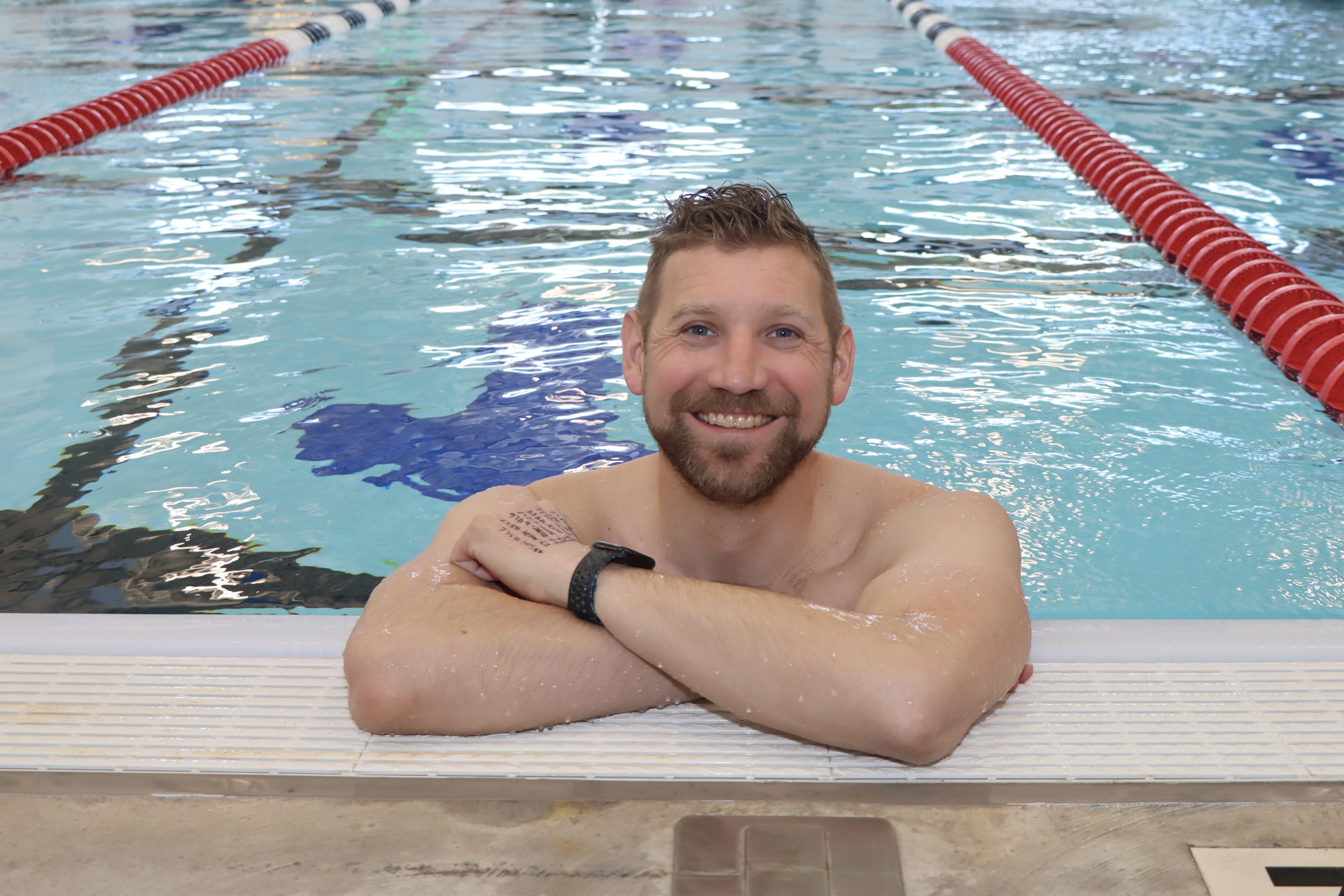
Week 1 of 42
A 15-minute hotel workout, an old injury fear, and the decision to stop contemplating a return and finally begin one.
It was only a 15-minute workout, and I thought I had already hurt myself.
A couple sets of pull-ups, some dumbbell squats, and a few other low-key exercises should not have left me feeling like this. I hadn’t lifted anything heavy. I hadn’t done many repetitions. I had deliberately taken it easy.
But there I was, back in my hotel room, feeling a sharp pain along my right side and wondering whether my next swimming season had ended before it began.
It was July 15, and I was in Austin, Texas, for work. The Westin where I was staying had a very nice fitness center, and I had finally decided to use it.
That alone was progress.
I had not trained seriously since the Colorado Masters Swimming State Meet in April. I had done some running before a family 5K on July 4 and completed a couple of challenging bike rides with a friend, so I wasn’t starting from zero. But I had not lifted consistently, and I had not been in a pool once.
My home gym had spent most of the summer sitting untouched, by me, at least.
Then my wife planted a seed.
“You know, the 2027 USMS National Championships would actually fit into our schedule,” she told me. “I think you should do it.”
The meet that never fit
I have competed in Masters swimming during four of the past five seasons. Nationals has been somewhere in the back of my mind during each one, but it never felt realistic.
My wife has been working toward running a marathon in every state for more than a decade. She has completed 32 states, and her races are an important part of our family calendar. Our children are also competitive runners, and their meets are a priority for both of us. Add work trips, school, family vacations, and everything else that comes with raising children, and there are only so many weekends available.
Nationals always seemed to lose the scheduling competition.
This time was different.
The meet will be in California, about as close to Colorado as I can reasonably expect it to be. It won’t conflict with any of our kids’ meets, and attending won’t prevent my wife from completing a full marathon schedule.
For once, nationals fit.
I wasn’t even the one pushing hardest to make it happen. My wife was. She has remained a serious runner throughout our entire adult lives, while I spent 15 years believing that my competitive swimming career belonged to my past. She knew what committing to a goal could give me, and she believed this was the year I should find out what I could still do.
Her suggestion transformed nationals from an idea into a decision.
I was going.
The swimmer I had been
Swimming was central to my life from second grade through college. For 15 years, it was my identity, my outlet, and my path forward.
I was a top age-group swimmer in Illinois and eventually received a full-ride scholarship to a Division I school, Eastern Illinois University. At EIU, I improved each season and graduated with school records in the 50, 100, and 200 freestyle and the 100 and 200 backstroke.
My college career was everything I could have hoped for. But after college, there was no obvious next step. I wasn’t going to make an Olympic team, and professional swimming was not a meaningful career option for someone at my level.
So I moved on.
I built a career, got married, had children, and moved from Illinois to Colorado. Work and family brought me more happiness and fulfillment than I could have imagined. But the part of me that identified as a swimmer never completely disappeared.
In 2008, shortly after my college career ended, I had a swimmer tattooed over my heart. At the time, it seemed like a way to honor something that had defined most of my life.
Over the next 15 years, it became something more. Every time I took off my shirt, it reminded me that the swimmer was still there, even when I wasn’t swimming.
In 2022, I finally returned.
A search led me to the Foothills Masters Swim Team at my local recreation center. The coaches and swimmers welcomed me in a way that made returning possible. Since then, I have competed at four Colorado state meets, won my age group’s high-point award each time, and set three individual state age-group records.
But the season that changed what I thought was possible came in 2025.
The season I wanted back
After taking the entire 2024 season off, I returned to the pool in August and trained consistently through the April 2025 state meet. It was the longest and most consistent stretch of Masters training I had completed since returning to the sport.
The results showed it.
I broke two individual state records, contributed to a record-setting relay that finished the season ranked first in the country, and swam times I had not seen since high school. Most of my performances ranked among the top 10 nationally in the 40 to 44 age group. Several were in the top five, and one ranked second.
The 2025 season proved that I could still be more than a good former swimmer. With enough preparation, I could compete at a high national level again.
I entered the 2026 season intending to build on that success. I returned in August, trained heavily, and was already swimming excellent times by November.
Then December happened.
Family and work travel took me away from the pool for two weeks. I allowed a third week to slip past. Christmas arrived during the fourth. By the time I returned on December 26, I had gone 24 days without swimming.
My mind was ready to resume training. My body was not.
During a 3,000-yard workout, I completed a set of 10 100-yard pulls with paddles. Somewhere in that set, I felt an unfamiliar pull in my chest. I tried to ignore it, but by the end of the workout I knew something was wrong.
Within days, I could not lift my left arm over my head without feeling as though a rubber band in my chest was being stretched to its breaking point.
A doctor diagnosed a strained serratus anterior, the fan-shaped muscle that connects the upper ribs to the shoulder blade and helps control overhead movement. Fortunately, the injury did not require surgery. It did require rest and a round of physical therapy.
I returned to the pool near the end of January and eventually regained pain-free movement. But my training never recovered its earlier consistency.
At the 2026 state meet, I still won more races than I lost. I won my age-group high-point award and finished as the overall high-point swimmer at the meet. On paper, it was a successful weekend.
It didn’t feel that way.
My times were nowhere near what I had produced in 2025. I lacked the endurance to race every event the way I wanted and had to survive a few races rather than attack them.
The season that was supposed to improve upon 2025 became a muted version of it.
Injured after 15 minutes?
That history followed me into the hotel gym in Austin.
After my wife and I decided that nationals could finally happen, I wanted to begin doing something. A coworker I talked with on the work trip is consistent about exercising while traveling, and our conversations helped push me into the fitness center.
Then 15 easy minutes left me standing in my hotel room with pain in my right side.
I am familiar with ordinary post-workout soreness. This wasn’t that. This felt like the kind of pain that says either “you did too much” or “something is wrong.”
My thoughts immediately returned to physical therapy, missed practices, and the previous season slipping away.
Was I really going to improve on 2025 if my body couldn’t handle a light hotel workout? Was I about to lose another season before completing a single lap?
The next morning, the pain was still there. I flew home feeling discouraged and, irrationally, annoyed with myself for working out at all.
That wasn’t fair. I hadn’t gone too hard. I had merely started.
Sometimes starting hurts.
I rested and stretched for the next few days. Thankfully, the pain subsided. I had not suffered another serious strain. I had irritated something just enough to frighten myself.
On July 19, I went into my home gym and completed a light 35-minute workout. I did some basic bench presses, dumbbell curls, and other familiar exercises. I didn’t feel particularly strong, but nothing hurt.
That was enough.
Monday would be my first swim.
The difficult part of returning
Physically, I knew the first practice would be uncomfortable. That wasn’t what made me hesitate.
Most of my teammates swim throughout the year. They don’t follow my pattern of training hard, disappearing for months, and eventually returning. The coaches have always welcomed me back enthusiastically, and I knew they would be excited to hear about my plans for nationals.
Still, returning after a long absence feels strangely awkward.
There would be new swimmers who had joined while I was away and familiar swimmers who might be gone. Someone would probably comment on my return, not maliciously, but enough to make me explain where I had been. I wondered whether there would still be room in my usual lane and what the swimmers who had trained consistently all summer really thought about seeing me again.
None of this should bother me. In my work, I meet new people and say goodbye to others all the time. I have friends on the team, plenty of friendly faces, and no one I dread seeing.
The discomfort comes from me.
It comes from knowing that my approach is unusual. It comes from the insecurity of returning to a place where everyone else kept doing the work while I was gone. It comes from wondering whether I still belong in the position I occupied before I left.
Starting again means confronting more than lost conditioning.
It means walking back through the door.
The chase begins
I am counting this as Week 1 of a 42-week journey to the 2027 USMS National Championships, where I will compete at 42 years old.
The numerical coincidences continue. I will complete 41 weeks of actual swimming preparation and spend most of that time at age 41. The 1,000-yard freestyle, probably my best opportunity to produce the top time in the country, is 40 lengths of a 25-yard pool.
Forty. Forty-one. Forty-two.
More important than the numbers are the three goals behind them:
Three goals
- Arrive at nationals healthy and prepared to compete at my best.
- Win every event I enter, or as many of them as I possibly can.
- Produce at least one time that finishes the season ranked first in the country for my age group.
Winning nationals and recording the country’s fastest time are separate goals. Not every top swimmer attends the national meet, so it is possible to win an event without finishing the year ranked first. It is also possible to record the country’s fastest time at another meet without winning nationals.
I want to test both standards.
At 41, with a wife, children, a full-time career, frequent travel, an inconsistent training history, and a recent injury, where is my limit?
Over the next 42 weeks, I intend to find out.
But first, I had to return to the pool.
Monday morning was waiting.
Follow Chasing My Limit
Follow this 42-week journey to the 2027 USMS National Championships. Subscribe to receive the next chapter when it is published.
Leave a Reply