
Week 8 of 42
Training week: August 31 to September 6, 2026
For most of the week, my body kept accepting more work. Then one stroke changed the question from how much I could do to whether I had already done too much.
I went to bed Sunday night feeling like my body was adapting to the work.
By Monday morning, it had filed a different report.
My lower back ached from a long bike ride. My right pectoral was tight after a heavy chest workout. My motivation had apparently received the week’s schedule, but my back and chest had not.
The good news was that none of the discomfort was mysterious. I knew exactly what I had done to cause it, and nothing felt like a new injury. Even the shoulder soreness that had concerned me the previous week was gone, despite two customer golf events. The PT and strengthening work appeared to be doing its job.
Still, the revolt was unwelcome. I had completed 11 workouts the previous week and gone to bed feeling almost invincible. I wanted to begin again Monday as if the bill for that work would never arrive.
Consistent training would not mean waking up fresh every morning. It would mean learning which discomforts could come with me to practice.
So I took the soreness with me.
The week I had been waiting for
This was my first full week at home since beginning the journey. There was no work trip, family travel, or visitor altering the schedule. Outside of normal work and family responsibilities, the calendar was open.
I had been looking forward to it. I wanted at least four swims, my regular lifting, and some running. Another 11-workout week was not only possible. It was on the menu.
Monday’s practice included nearly 800 yards of butterfly within a 3,500-yard workout. I usually avoid fly, but I want to improve it this season rather than continuing to treat it as a stroke I merely survive.
My back loosened as I swam. My chest did not, but something strange happened when I increased the effort. The faster I swam, the less I noticed it. The response left me confident that I was dealing with soreness rather than injury.
I finished the day in my home gym with PT work and lifting that didn’t load my chest again.
One swim. One lift. The week was underway.
Fifteen 200s and one generous concession
My chest felt better Tuesday morning, which was fortunate because our coach had scheduled what he called an “old-school” distance set.
We had three options. I chose 15 x 200s.
The main set alone totaled 3,000 yards. That made it ideal preparation for the endurance I will need in the 1,000 freestyle. It also made it longer than I was fully prepared to lead.
Thankfully, AJ, one of the younger and faster swimmers on the team, was willing to take the front. I generously allowed him to perform the hydrodynamic work for both of us.
Drafting behind another swimmer reduces some of the resistance. It does not eliminate the work, but it makes holding the pace a little easier, especially when the swimmer ahead has a steady kick.
I am accustomed to leading the lane, so swimming behind AJ felt slightly like cheating. At the same time, only one person can lead. The small advantage was exactly what I needed to complete a demanding set without turning it into a survival exercise.
We began at approximately 2:05 per 200 and never slipped much beyond 2:15. Earlier in this journey, simply finishing 15 x 200s would have been difficult to imagine. Now I was completing them at a solid pace.
By the time practice ended, I had swum 4,500 yards, my longest workout since returning to the pool.
That evening, I ran one easy mile to keep my legs moving before another family 5K on Labor Day.
One mile isn’t much, but it’s still something.
I have believed in something over nothing for years. People often decide that a workout has to be long, hard, or impressive to count. The big version feels overwhelming, so they do nothing instead.
A walk is better than the couch. Fifteen controlled minutes in a hotel gym are better than skipping the day. One mile is better than zero.
The work doesn’t have to be remarkable to move you forward.
A rest day, technically
By Tuesday night, I had already swum 8,000 yards, lifted once, and run once. I had considered swimming Monday through Friday, but four workouts in two days convinced me not to set a Wednesday alarm.
The surprising part was that I wanted to set it anyway.
Earlier in the journey, getting myself to the pool had been the challenge. Now I had to make a deliberate decision not to go. I nearly ran Wednesday evening too, but decided a moderate lift made more sense.
Yes, my rest day included lifting.
My Apple Watch deserves some of the blame. It tracks daily movement, exercise, and standing with three rings, then rewards consistency with streaks. My streak had been intact for more than a month, and Wednesday’s rings were looking uncomfortably empty.
I knew the streak was arbitrary. I also knew I wanted to keep it. I completed a controlled gym session, filled the rings, and accepted my highly qualified version of rest.
The routine was beginning to hold. I had now completed at least two swims in seven consecutive weeks. More importantly, I no longer needed to negotiate with myself every time an opportunity to train appeared.
The concern was shifting in the other direction. I had to learn when an opportunity was not an obligation.
Speed recognizing speed
Thursday morning was a struggle, but I wanted a third swim and knew that staying in bed would not produce one.
The workout focused on sprinting. We moved through 25s and 50s, sometimes with fins and sometimes without them. Fins create a speed that is difficult to reach naturally and force the arms to keep up. If you want to swim fast, it helps to remember what fast feels like.
Scott and I pushed each other throughout the practice. By the end, we were both tired and wanted to find out what we could produce from the blocks.
Scott is considerably younger and has trained more consistently than I have. I was a college sprinter. He was a distance swimmer who has developed his speed as a Masters swimmer. Over 50 or 100 yards, we are usually well matched.
Our coach called us to the blocks.
I wanted to beat him.
My start was solid, and we surfaced nearly even. I reached the first wall slightly ahead, then gave away the advantage with a turn that was too tight. Scott’s powerful dolphin kick moved him ahead as we began the second length.
I spent the final lap pulling back the distance one stroke at a time. The race came down to the touch. I stretched my long frame toward the wall and looked into the lane beside me as Scott arrived with me.
From what I could see, we touched together.
Our coach looked at his stopwatch.
“23.3. It was a tie!”
The time brought a little excitement from the teammates waiting to complete their own sprints. Scott smiled and gave me a fist bump.
Speed recognizing speed.
A 23.3 at the end of a difficult practice was more than I expected seven weeks after returning to the pool. At this stage, the accumulated training could easily have buried my sprint speed.
Instead, the old sprinter was still there. He apparently enjoys being challenged.
A dangerous possibility
Friday provided a different kind of evidence.
The workout was built around four rounds of a 250, four 50s, two 100s, and four 25s. Each round carried different instructions. During the final one, I pushed the four 50s to approximately :27 apiece and followed them with consecutive 100s at :57.
Those times came late in the practice, after fatigue had accumulated. That was exactly what made them encouraging. The speed was no longer appearing only in isolated moments. It was beginning to survive exhaustion.
A 57-second average over ten consecutive 100s would produce a 9:30 in the 1,000. The national record for my age group is 9:32.
I had not seriously considered a national record part of this pursuit. Suddenly, the math placed it close enough to think about.
There is an enormous difference between swimming two 100s at :57 with rest and holding that pace ten times without stopping. Friday did not prove I could break a national record. It suggested that dismissing the possibility might be premature.
That was incredibly motivating.
It was also dangerous.
Would thinking about a national record cause me to push too hard? Was I creating a new way to disappoint myself? Both possibilities were real. But big achievements rarely begin with a perfectly reasonable thought.
Watching the swimmer from the outside
This journey has already pushed me toward things that are new. Writing a weekly blog is new. Recording Instagram Reels is new. Seeing myself swim underwater was entirely new.
Despite more than 20 years in competitive swimming, including four years at a Division I university, I had never been filmed underwater. The equipment required to do it well was expensive when I was younger. Now a $20 case could turn my phone into the camera my college program never had.
I handed the phone to a teammate and asked him to record my freestyle and backstroke.
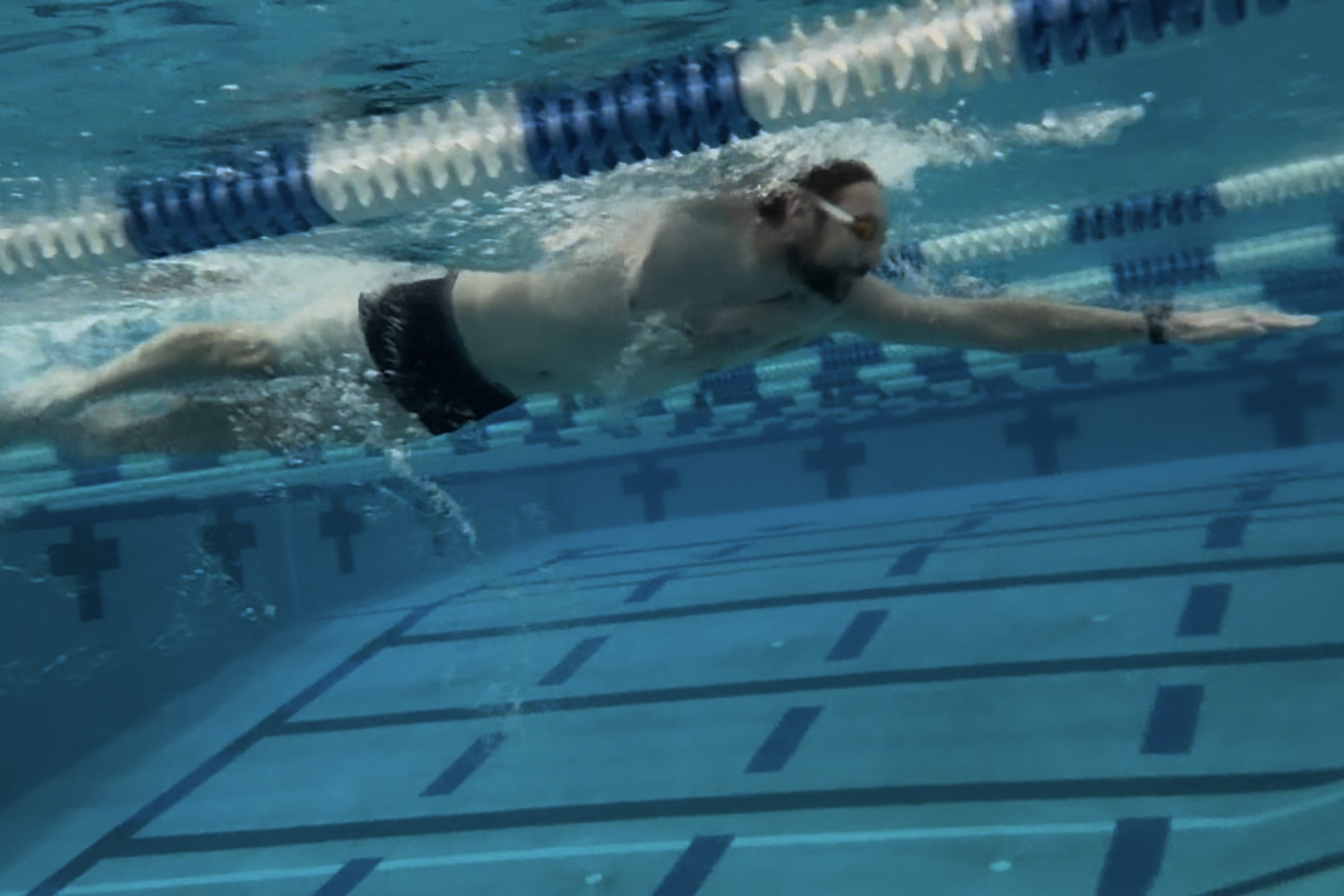 Freestyle
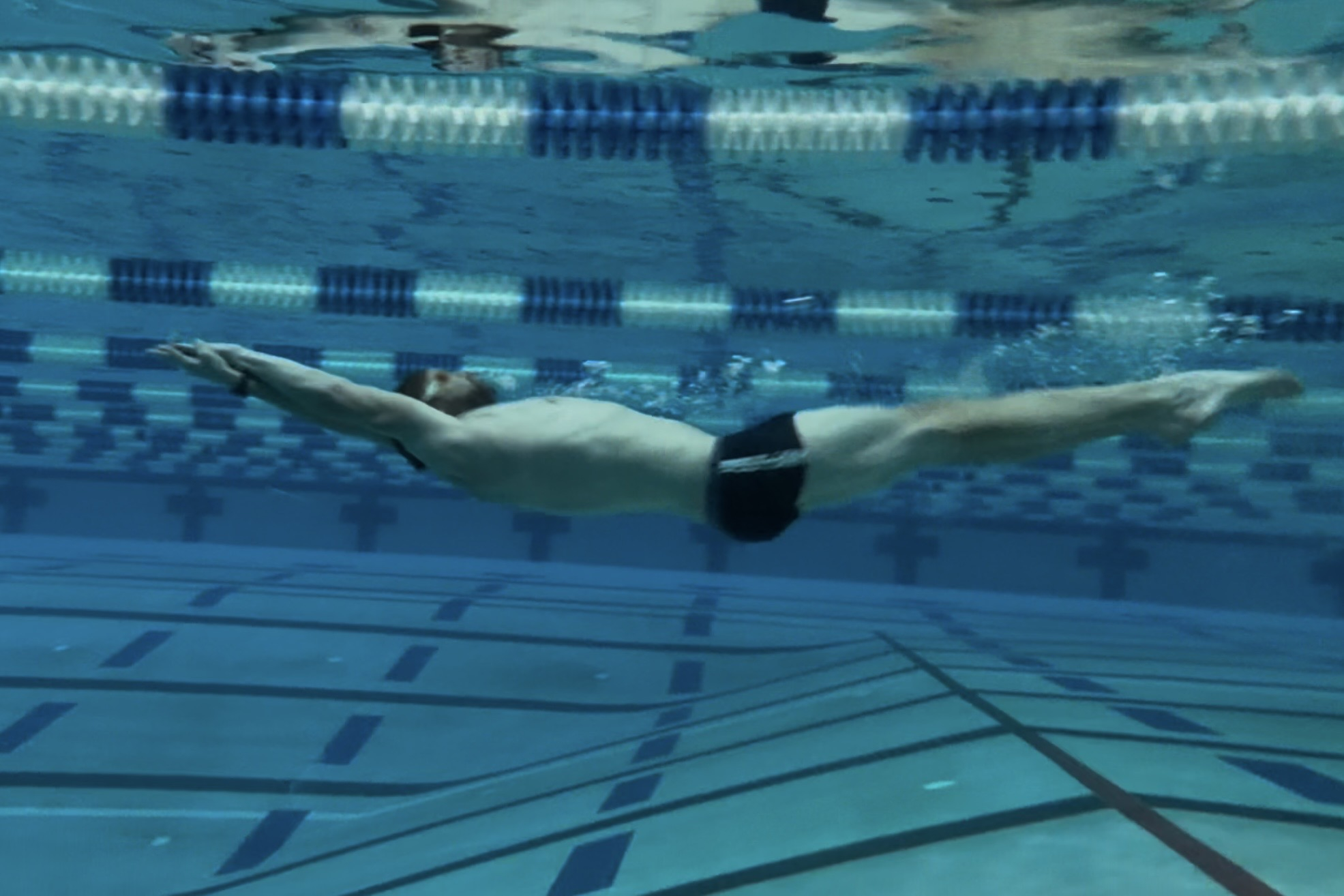 Backstroke
Watching the footage was surreal. I had experienced the swimmer for decades entirely from inside my own head. For the first time, I could study him from the same perspective I once used when coaching other athletes.
Some things looked better than expected. My backstroke dolphin kick appeared powerful. My freestyle had a long, effective reach with my right arm.
Other things gave me immediate work. My legs sat too low during the second length of backstroke. My left arm began its freestyle pull too quickly.
They were small details, but they were details I had never been able to see. I have spent years knowing what good freestyle and backstroke should look like. Now I could finally apply that eye to myself.
The image at the top of this post came from that session. For once, the swimmer I was chasing was no longer visible only in my memory or imagination.
November is coming
I am also studying an older kind of footage: my training logs from the previous two seasons.
Through the first six weeks, both seasons looked remarkably similar to this one. The number of swims and total yardage were nearly identical. In 2024 and 2025, Week 7 also represented a noticeable increase.
Both seasons remained fairly consistent through October. Then November weakened. In December, the wheels came off.
During the 2024 to 2025 season, I recovered in January and became fully consistent again in February and March. That led to my best Masters performances at the April 2025 state meet.
The following season was less forgiving. A weak November and mostly absent December preceded the serratus injury that cost me January. February and March never fully recovered, and my April 2026 state performance reflected it.
The pattern is difficult to ignore.
November and December are also difficult months in my actual life. Work travel accelerates before year-end. My children’s cross-country season reaches regional and national championships. In previous years, both forms of travel became reasons not only to miss swimming, but to stop training almost entirely.
This year, I began five or six weeks earlier. I have already proven that travel does not have to eliminate exercise. The blog adds accountability I didn’t have before.
I don’t want to sit down after an empty week and explain why I did nothing.
That accountability can help protect consistency. It can also encourage me to chase a workout simply because I want a satisfying number to report. Forty-two weeks is a long time. Week 8 is far too early to begin treating maximum volume as the minimum acceptable result.
The warnings arrive
My knees had already started objecting.
They hurt during Tuesday’s run and remained achy during Thursday’s swim. I felt them while pushing off the walls and during dolphin kicks. Nothing suggested an injury. The downhill 5K and inconsistent running had simply left a reminder that cross-training creates its own recovery demands.
Friday brought a more alarming sensation.
After pulling with paddles, I rolled onto my back for an easy 50. Before the first length ended, I felt a pulling sensation in my right lat.
My mind immediately returned to the left-side serratus injury that derailed the previous season. The location was different, but the beginning felt familiar enough to get my attention.
I switched to freestyle. The sensation disappeared.
I considered ending the workout. I was already approximately 3,000 yards into it, and stopping would have been defensible. But I was swimming well, the pain had not returned, and I wanted to continue.
I eased into the next portion. Nothing happened. I completed the workout and later lifted without another warning.
By Saturday, the incident felt like a false alarm.
I had already swum four times, run twice, and lifted three times, so I avoided additional cardio. By evening, however, my Apple Watch rings remained empty and apparently so did my ability to leave them that way.
I went downstairs and completed a substantial chest-and-back workout. Pull-ups, straight-arm pulldowns, rows, barbell bench press, incline dumbbell press, and flyes filled the rings and emptied the tank.
I went to bed satisfied.
One more swim
Most Sundays, my wife’s long run keeps me from attending the team’s 7:30 a.m. practice. That weekend, my wife and children had all run Saturday. Sunday morning was open.
I already had four swims and 14,500 yards. It was my best swimming week of the season. There was no need to add another workout.
But the opportunity to make it a five-swim week was too good to pass up.
I chose the sprint workout because I had already completed plenty of yardage. Warmup went well. The first round of the main set caused no concern.
Then I began the backstroke portion of the second round.
During the first 25, I felt the same pulling sensation that had appeared Friday. This time it was stronger and more centralized around my spine.
I rolled onto my stomach and tried freestyle. The pain stayed.
At the wall, I stretched what felt like a knot in the upper middle of my back. It wouldn’t release. Every stroke hurt. Taking a deep breath hurt. I couldn’t generate any power.
Logic said I should stop.
I did not want to give up. Part of me hoped the pain would disappear if I kept moving. Another part didn’t want to show weakness by climbing out.
The pain made the decision for me. I couldn’t continue swimming normally, so I put on fins and kicked through the remainder of practice.
Afterward, I tried to determine what I had done. The pain occupied a familiar area where a disc in my back has occasionally bulged. When that happens, a few painful days usually resolve it.
The other possibility was less comforting. I had completed a hard back-focused lift the night before. If I had strained a muscle, recovery might require more time and another round of physical therapy.
Only time would distinguish one from the other.
Training snapshot
- Swims
- 5
- Swim yardage
- 17,300
- Strength and PT sessions
- 4
- Runs
- 2
- Run distance
- 3 miles
- Total workouts
- 11
- Longest swim
- 4,500 yards
- Fastest timed 50
- 23.3 seconds
I ended Week 8 with five swims and 17,300 yards, both season highs. I also completed four strength sessions and two runs. Before Sunday, my body had appeared increasingly willing to accept everything I gave it.
The week had produced my longest practice, the fastest timed 50 of my comeback, back-to-back 100s that suggested a national record might not be an absurd thought, and the first underwater view of my own swimming.
It had also produced sore knees, one warning in my lat, and a second warning that left me unable to swim or breathe without pain.
Momentum had arrived. The question was whether I had learned how to manage it before it began managing me.
For most of the week, I had been asking how much work I could fit into a body that seemed increasingly willing to accept it.
By Sunday morning, the question had changed. My back hurt when I swam. It hurt when I breathed. It hurt when I did almost anything.
In less than 24 hours, I was supposed to run another 5K.
Follow Chasing My Limit
Follow this 42-week journey to the 2027 USMS National Championships. Subscribe to receive the next chapter when it is published.


Leave a Reply