Week 16 of 42
Training week: October 26 to November 1, 2026
For years, business travel existed outside my swimming life. One uncertain hotel pool changed what I believed could fit inside a work trip.
I walked along the length of a hotel pool in Nashville, trying to measure it with my arms.
I’d already swum twenty-five lengths under the assumption that the pool was twenty yards long. That gave me what I thought was a 500-yard warmup. Then a lifeguard corrected my math.
The pool wasn’t twenty yards. It was twenty-five meters.
My warmup had actually been 625 meters, and the business trip I’d worried might interrupt my swimming had just handed me a legitimate training pool.
I’d researched the pool before leaving home, but nothing online confirmed its length. The best description I could find called it a large rectangular pool used by guests for lap swimming. It had no lane lines, and one review advised arriving early enough to avoid sharing it with guests who were there to relax.
I packed my swimsuits and goggles anyway.
I’d exercised during work trips before. I’d run near hotels and used their fitness centers. But I’d never completed a real swim workout during one.
This trip stretched from Monday afternoon through Thursday afternoon. After racing at Sunday’s meet, I wasn’t going to swim before my flight. We had family plans Thursday evening, Halloween was approaching, and I couldn’t find two reliable opportunities to swim at home.
For the first time, swimming during a business trip didn’t feel like an optional bonus. It felt necessary if I wanted to protect the minimum standard I’d set for myself.
Finding the pool
Hotel pools are rarely built for serious training. A ten-yard pool doesn’t become useful merely because someone calls it a lap pool. Finding an off-site competition pool requires transportation, admission fees, extra time, and a schedule that cooperates. A single swim can easily become a thirty-dollar excursion that consumes an entire evening.
This time, the possibility was inside the hotel. Planning to use it and actually getting there were still two different things.
I flew to Nashville Monday, checked into the Gaylord Opryland Resort, and almost immediately left for dinner with customers and colleagues. By the time we returned, it was after 8 p.m. Some people continued their night downtown. Others headed to bed before the conference began the next morning.
I still wanted to swim.
The pool was only open from 8 a.m. until 10 p.m., the same hours that framed most of the conference. The resort was so large that I received a map with directions to my room, and finding the pool required navigating across one floor, over a terrace, and back down to another entrance.
My first attempt ended outside the main lobby asking someone for directions.
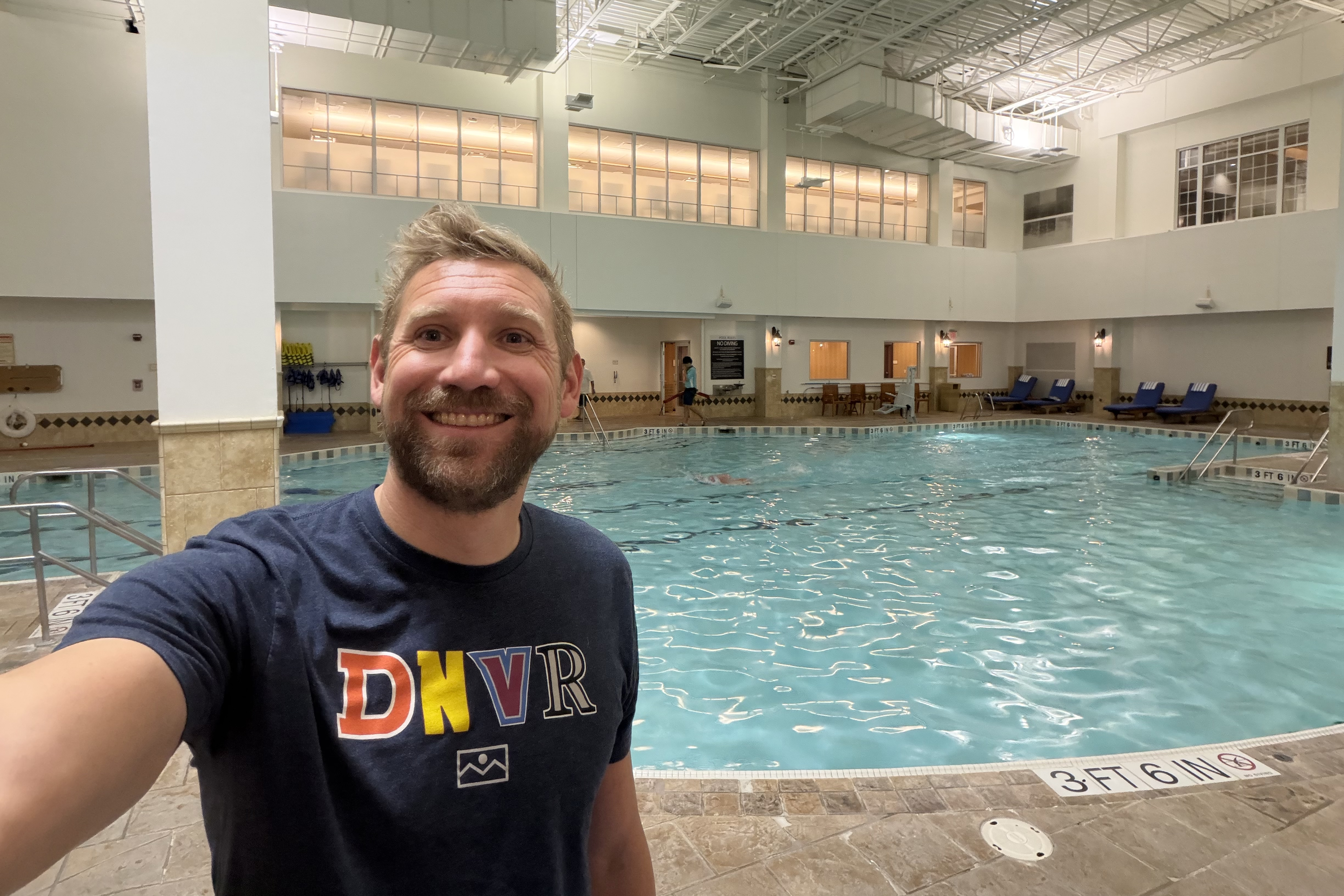
Eventually, I found it. The pool was a large rectangle with lane markings on the bottom, even if no ropes separated them. Only one other person was in the water, and they were swimming laps.
I returned to my room, changed, and navigated the route again.
As soon as I entered the water, another problem became obvious. If Sunday’s meet pool had been warm, this one was hot. My watch later estimated the water at 86 degrees. Whether that number was exact or not, my body agreed that the temperature was far above what I wanted for training.
I started swimming anyway.
A thousand with nothing to prove
After learning that my warmup had been 625 meters, I swam a straight 1,000.
I wasn’t trying to repeat Sunday’s race or improve upon my 10:50. I wanted distance, rhythm, and enough work to make the effort worthwhile. The hot water made sustained swimming uncomfortable, but I kept a solid pace and finished in 13:16.
The time looked much slower than the race I’d completed one day earlier, but nearly every condition had changed. This was meters rather than yards. I was alone rather than surrounded by teammates. The pool was extremely warm. I’d traveled and attended a customer dinner after racing the day before.
The one advantage was altitude. Nashville sits at roughly 600 feet, while my regular training and Sunday’s meet took place around 5,500 feet.
Converting the swim to yards put the effort around 11:53. I had swum only about a minute slower than Sunday’s race without racing, without resting beforehand, and in water that made hard swimming difficult.
It was an imperfect comparison, but it gave me another reason to believe that racing at sea level could matter at Nationals.
I continued until I reached 2,500 meters. I would have gone farther, but the lifeguards dimmed the lights at 9:45 despite the posted 10 p.m. closing time.
I had to stop.
But I’d done it. On the first night of a business trip, after travel and a customer dinner, I’d completed a legitimate swimming workout.
I was no longer a swimmer who could train only when I was home. I was becoming someone who found a way to swim wherever the rest of life took me.
The pain that disappeared
After the swim, I noticed something else. The upper-back pain that had spent weeks on my left side and then appeared on my right during Sunday’s meet was gone.
My back remained slightly stiff, but the pain itself had disappeared. I didn’t make much of it. Swimming often provided temporary relief, only for the discomfort to return after a night in bed. I assumed the same pattern would repeat.
It didn’t.
I woke Tuesday without pain. Then I remained pain-free throughout the day.
Less than a week after my doctor had identified a likely rhomboid strain, the sudden shift made me question whether that diagnosis explained the full problem. The pain had moved from one side to the other and then vanished. That pattern reminded me more of previous episodes I’d associated with a bulging disc than a single strained muscle.
I couldn’t know that for certain without further medical evaluation. I only knew that the pain wasn’t behaving the way I’d expected.
The relief was enormous, but it carried its own uncertainty. Would one wrong movement or bad night of sleep bring everything back? Why had this episode lasted so much longer than the previous ones?
For the moment, I had no definitive answer. I could continue the rehabilitation work, monitor what happened, and appreciate being able to move without pain.
Choosing the pool
Tuesday brought a full day of meetings followed by an evening event with an open bar and a private concert.
I spent the reception talking with coworkers and customers, then stayed for roughly the first thirty minutes of the show. The band was good, but the room was dark, the music was loud, and the setting no longer offered much opportunity for conversation. After a day spent engaging with people, I was restless and needed to decompress before doing it again Wednesday.
The pool would close in less than an hour.
I felt a little guilty leaving early. The concert was meant to be an opportunity to unwind, and the open bar was part of the experience. But I haven’t consumed alcohol in roughly two years. I didn’t stop because of a medical crisis or addiction. I stopped because removing alcohol felt best for my life and my athletic ambitions.
That doesn’t mean the temptation disappeared. Being one of the only sober people in a group where others are drinking can feel awkward. One free beer or bourbon would be easy to justify. The harder question is what breaking the streak might reopen afterward.
I was happy with the life I’d built without drinking. An open bar and social pressure weren’t good reasons to change it.
I slipped away around 8:30, changed, and returned to the pool.
This time, I had the entire pool to myself.
I completed a 500-meter warmup, followed by sets of 100s and 200s. The temperature limited how hard I could push, but I finished another 2,500 meters before the lights dimmed at 9:45.
I returned to my room feeling better than I would have after staying at the concert. The swim hadn’t competed with the trip. It had given me the physical and mental reset I needed inside it.
It was only Tuesday night, and I’d already protected my two-swim minimum.
Strength without proving anything
I woke Wednesday pain-free again.
After another full day, part of me wanted to return to the pool. Another part recognized that I’d already swum Sunday, Monday, and Tuesday. My shoulders and back felt fine, but easy access wasn’t a reason to swim four consecutive days.
I used the hotel gym instead.
I ran half a mile on the treadmill, then completed a controlled strength session with dumbbell bench presses, curls, goblet squats, and several rhomboid rehabilitation exercises.
I continued the rhomboid work even though I was questioning whether a muscle strain had caused the pain. The muscles still support nearly everything I do in the pool, and I’d never specifically strengthened them before. The diagnosis could be incomplete while the recommended work remained useful.
Restraint didn’t mean that fear had won. It meant I no longer needed every available workout to become a test of how much my body could tolerate.
Thursday morning brought one more opportunity. My flight wasn’t until early afternoon, so I returned to the pool for a straight 1,000-meter warmup and another 1,000 meters of shorter repeats.
In four days, I’d completed three hotel swims totaling 7,000 meters.
I’d packed my goggles hoping to protect a minimum. I flew home having expanded what I believed was possible during a work trip.
Training snapshot
- Swims
- 3
- Swim distance
- 7,000 meters
- Runs
- 1
- Run distance
- 3 miles
- Strength sessions
- 3
- Halloween walk
- 4 miles
- Total workouts
- 8
What swimming hadn’t preserved
When I returned home Thursday, a change in our evening plans created time for another workout.
I’d been neglecting running, even though I’d once imagined it becoming an X factor in my training. I chose a familiar three-mile loop and started fast.
The first mile felt good. The second was slower but steady. By the third, everything hurt.
My shins, knees, and feet protested. I walked most of the final mile, and even walking was uncomfortable.
The run exposed a truth that swimming had temporarily hidden. Fitness isn’t one universal account. Being well trained in one movement doesn’t prevent another from revealing what you’ve neglected.
My swimming had improved. My running endurance hadn’t been waiting patiently for me to return.
Friday became a true rest day. I was too tired for the 6 a.m. practice, work prevented me from attending at 10:30, and after a demanding week I wanted an evening with my family. I’d already completed three swims, one lift, and one run. Rest felt earned and appropriate.
Adding back what I’d avoided
Saturday, I spent forty minutes lifting in my home gym. I focused on chest and biceps, then cautiously added dumbbell rows, a movement I’d avoided because it sometimes aggravated my back.
I kept the weight light and moved slowly. Nothing hurt during the workout.
That evening, my children pursued a different kind of endurance goal while trick-or-treating. They wanted to cover at least a 5K while maximizing their candy haul.
We walked more than four miles over roughly two hours, and they collected more than twenty pounds of candy. It wasn’t a hard run, but it was meaningful movement that didn’t require disappearing from the family or treating the holiday like an obstacle to my training.
We stayed up late, and I ate far more candy than I should have.
It was a great night.
I slept through Sunday’s swim opportunity. I regretted missing the chance for a fourth session, but my back still didn’t hurt and the week had already contained plenty of work.
I accepted the slower morning, then returned to the weight room that evening for shoulders, triceps, deadlifts, standing resistance-band rows, and leg work.
The rows were another careful step toward restoring the work I’d avoided. The leg exercises were a response to what Thursday’s run had revealed.
The week ended with eight workouts after two consecutive weeks with only six. More importantly, it ended without the pain that had restricted both my training and my thinking.
For years, business travel existed outside my swimming life. I might use a hotel gym or pack running shoes, but swimming stayed home. It required too much planning, too much equipment, and too much cooperation from a schedule I didn’t control.
In Nashville, I packed for the possibility, found the pool, and returned twice after the first success. The three swims didn’t happen because the trip became less demanding. They happened because training had become important enough to claim a place inside it.
The next time I leave home, I won’t wonder whether I’m someone who can swim during a business trip.
I’ll only need to find the pool.
Follow Chasing My Limit
Follow this 42-week journey to the 2027 USMS National Championships. Subscribe to receive the next chapter when it is published.

Leave a Reply