Week 11 of 42
Training week: September 21 to 27, 2026
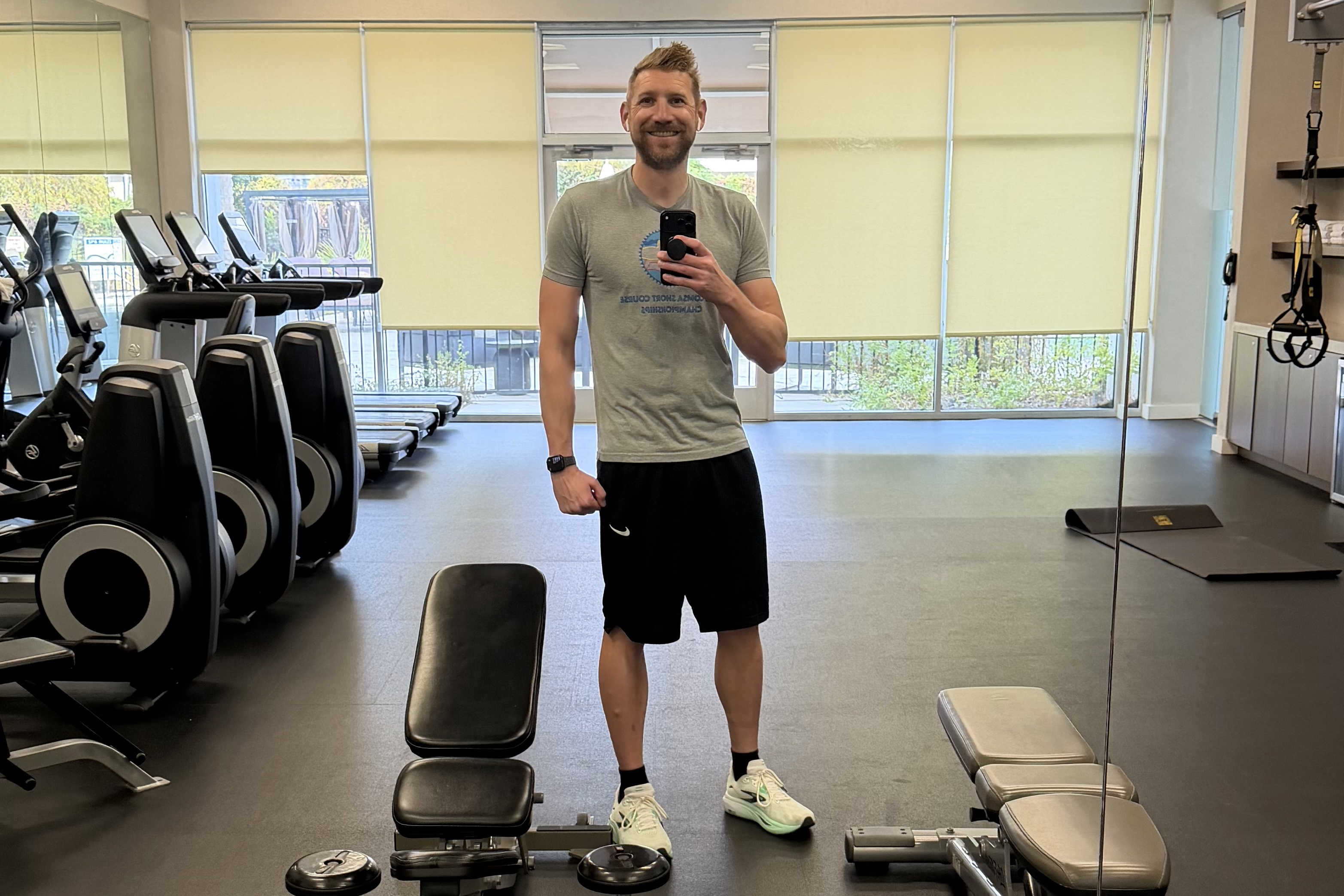
Ten weeks ago, 15 minutes in this hotel gym helped launch the journey. Now two workouts on a travel day felt too ordinary to celebrate.
Ten weeks earlier, I had walked into this same hotel gym in Austin and completed a tentative 15-minute workout.
At the time, even that small effort felt significant. I hadn’t returned to the pool, Nationals was still more of an idea than a plan, and I wasn’t sure my body could handle much of anything without getting hurt.
A conversation with my teammate Jose helped push me into the gym that night. His example reminded me that the room was available if I was willing to use it.
Now I was back in the same place, but almost everything surrounding the workout had changed.
I had already run two miles before leaving Colorado, flown to Austin, and returned to the hotel gym shortly after checking in. This was not a tentative test of whether I could start exercising again. It was the second workout of the day and another entry in a routine that had begun to feel normal.
The same choice
Jose was already in the gym when I arrived.
We were both genuinely happy to see a familiar face, especially because we understood the choice the other had made. There was no formal team event that evening, but many of our colleagues were gathering at the hotel bar or heading out to dinner. We had no judgment about how anyone else chose to spend the open evening. Work travel offers valuable opportunities to socialize.
It also makes exercise easy to place at the bottom of the list.
The social choice is usually more visible. People notice who joins dinner or appears at the bar. Almost no one notices who quietly returns to a hotel room after exercising. That can make prioritizing fitness feel antisocial even when the event is optional and the decision reflects no judgment of anyone else.
We caught up as we lifted, completed a shoulder workout together, and enjoyed each other’s company. Our specific goals differ. I am training for a national competition and measuring progress through swimming, running, cycling, and overall workload. Jose focuses more broadly on strength, nutrition, and long-term health.
He uses an app that tracks the work completed by each muscle group. I use a spreadsheet that captures a 42-week journey. Different methods serve a similar purpose.
We talked about nutrition, supplements, and swimming as something he might add to his routine. We also talked about our children and why fitness matters beyond the next workout. Exercise consumes time today, but taking care of ourselves should create more healthy years with the people who matter most. It also gives our children an example of how health can remain a priority throughout adulthood.
Our tracking systems revealed the same contrast as our goals. His app evaluates whether each muscle group has received enough attention. My spreadsheet is less concerned with any single muscle and more interested in whether swimming, strength work, running, cycling, injury prevention, and real life are moving in the same direction. Neither approach is inherently better. Each gives us a way to make an invisible process visible enough to manage.
I told Jose that our July conversation had helped start the entire project. His encouragement contributed to my decision to enter the gym that night, and that workout helped move Nationals from something I was considering to something I was willing to pursue.
He was pleased, but he’s a humble guy and accepted the credit without making much of it.
The moment mattered because people rarely know how much influence a small conversation can have. Jose had not delivered a motivational speech or written a training plan. He had modeled consistency and encouraged me to do something.
Ten weeks later, that small push was still producing consequences.
After the workout, neither of us joined the gathering downstairs. We returned to our rooms to shower and rest. Pursuing a private goal sometimes means stepping away from the activity everyone else appears to be enjoying. That doesn’t make one choice morally superior. It means deciding which choice serves the life you’re trying to build.
When progress changes the standard
The symmetry of the Austin gym should have made the week feel triumphant.
Instead, it felt ordinary.
Ten weeks earlier, 15 minutes in the same room became the opening scene of this journey. Now I had run before my flight, lifted after arriving, and considered both workouts too normal to celebrate.
Progress doesn’t only expand what we can do. It changes what we expect ourselves to do.
The first time we overcome an obstacle, the effort feels significant. The fifth time, it feels routine. What once proved commitment becomes the minimum price of admission.
That rising standard can move us forward. It can also make us incapable of recognizing how much work we are doing.
Monday had been a strong day. I began with 3,000 yards despite being tired from Sunday’s run and lift and a late evening talking with my son. During the fastest portions of practice, I swam freestyle 100s in :54 and :53 and backstroke 100s around 1:01.
Later, I dropped my car at the repair shop and biked 3.4 miles home, then made the same trip in reverse when the car was ready. My legs felt dead, and neither ride was impressive. They were still miles accumulated through the practical needs of an ordinary day.
Tuesday morning, I wanted to swim and had time to do it before my flight to Austin. I simply couldn’t get moving when the alarm sounded at 5. I had stayed up later than I should have because I wanted more time with my wife before leaving for Austin.
Fatigue won the morning.
That distinction mattered. I hadn’t lost interest in swimming, and my schedule hadn’t prevented me from going. I had chosen extra time with my wife before leaving, then lacked the energy to answer the alarm. A 42-week journey has to leave room for decisions like that without pretending they carry no consequence.
Earlier in the journey, missing that practice might have eliminated exercise from the entire travel day. Instead, I ran two miles before my flight and lifted after arriving. Missing the preferred workout no longer meant losing the day.
Stubborn about the destination
Wednesday offered another opening between work sessions and dinner. I used half a mile on the treadmill as a warmup, then completed a 30-minute lift.
The session included lat pulldowns and TRX rows.
I knew that direct back work was contributing to the recurring knot near my spine, but I challenged that area of my body anyway. By bedtime, the pain had returned. By Thursday morning, it was strong enough to affect the entire day.
The recurrence was especially frustrating because the exercises hadn’t felt reckless. I hadn’t pushed for maximum effort or ignored pain during the session. I had used ordinary movements at manageable weights and still received the same answer. The problem was not only that my back hurt. It was that I could no longer tell myself I simply needed to be more careful while doing the same work.
This wasn’t a lesson about grinding through discomfort. It was a reminder that persistence and repetition are not the same thing.
I can remain committed to the larger goal while removing an exercise that isn’t serving me. Continuing to test my back every few days won’t make me tougher. It may only restart the same problem.
The grind requires stubbornness about the destination and flexibility about the route.
A flight built around a swim
Friday demanded another kind of commitment.
When I booked the trip, I deliberately selected an early flight so I could make it home for the 10:30 practice. That meant waking around 4:30 a.m. Central Time, which was 3:30 at home.
I got home around 9, talked with my family for a bit, and then went to the pool with the knot still present in my back.
The practice wasn’t particularly memorable, but it included three fast 100s where I held :59 on each. More importantly, swimming did not aggravate my back.
The workout preserved my two-swim minimum for the week and proved that I could follow through on a plan made before travel fatigue arrived.
The early flight was exhausting. I felt the effects through Friday and into Saturday.
Was it worth it? I think it was.
Without that flight, I would have fallen below the minimum swimming standard I established for this journey. The cost was real, but so was the reason for paying it.
That doesn’t mean I should choose the earliest possible flight home from every trip. Long-term goals are filled with tradeoffs that can’t be scored immediately. Friday’s swim protected consistency. The sleep loss reduced what I could offer later. Both statements can be true.
A full day without a workout
Saturday combined training with family support. Katie was completing an 18-mile run, and I joined her on my bike for the final six miles. The ride gave her company late in a difficult effort while giving me another chance to move my body.
Afterward, I completed an intense chest-focused workout that included close-grip and wide-grip bench press, incline dumbbell bench, flyes, squats, curls, and PT exercises. I avoided direct back work and trained the areas my body was allowing me to train.
Sunday became a genuine rest day, although it was hardly empty.
My children had their first club cross-country race of the season. My daughter competed against the top 11-and-12-year-old girls in the state, won her age group, and defeated a rival she had never beaten before. My son finished tenth in the highly competitive 13-and-14-year-old boys division, earning the final medal.
I volunteered to distribute medals instead of running around the course as I normally would. That cost me the opportunity to get exercise, but gave me the privilege of calling my daughter’s name as the winner.
Church and a music recital filled the afternoon. By the time we returned home, I didn’t feel capable of adding another workout.
For once, I allowed the day to feel complete without one.
Training snapshot
- Swims
- 2
- Swim yardage
- 6,100
- Strength and PT sessions
- 3
- Runs
- 1
- Run distance
- 2 miles
- Bike rides
- 2
- Bike distance
- 12.8 miles
- Total workouts
- 8
Eight workouts that felt like none
I remained active on five days, trained twice on Monday and Tuesday, exercised during a work trip, and protected my minimum swimming standard by planning air travel around Friday practice.
None of that resembles doing nothing.
Still, the week felt disappointing. I swam less than half of my planned yardage and ran only once. Several workouts were brief or less intense than I wanted. Recent weeks included more yardage, longer runs, faster milestones, and more total sessions.
Compared with those weeks, this one felt flat.
That comparison may have distorted my judgment. Ten weeks earlier, eight workouts would have been almost unimaginable. Now they felt insufficient. My standards had risen faster than my ability to appreciate meeting them.
The problem with comparing every week to a recent peak is that peak performance quietly becomes the new minimum. Eleven workouts had shown what I could accomplish under favorable circumstances. They had not established what every future week should contain. Treating the highest workload as the baseline would turn almost every ordinary week into evidence of failure.
What once represented transformation had become ordinary.
This was not a recovery week. Travel rarely leaves me rested, and eight workouts still create fatigue. It wasn’t a collapse either. I stayed engaged with the goal, used the time available, and kept the routine alive.
The week occupied the less dramatic territory between progress and retreat.
Most of a long journey probably occurs there.
The long middle
I don’t think every week needs one numerical minimum. Work travel, family events, physical warnings, and access to a pool will keep changing what’s possible.
The more useful boundaries are clear. An entirely empty week would be a major warning. Falling below two swims would suggest that the foundation was slipping. Everything above those boundaries must be judged within the circumstances that produced it.
That leaves more ambiguity than a fixed number, but a long season can’t be managed by one universal weekly score. Eight workouts during a work trip may represent greater commitment than eleven during an open week at home. The total matters. The choices required to produce it matter too.
The beginning of a difficult journey is emotionally generous. Nearly every action creates a milestone. The first workout matters. The first completed week matters. The first time we overcome travel or fatigue matters.
The ending has its own energy because the destination is visible and every remaining decision feels urgent.
The middle provides neither advantage. The novelty is gone, the finish remains distant, and the daily work becomes repetitive.
This is where motivation becomes less reliable and systems begin to matter more.
The grind is not one heroic workout. It’s running before a flight because the day will disappear otherwise. It’s entering the hotel gym while other people gather downstairs. It’s booking a flight around a swim, then accepting the exhaustion that follows.
It’s completing the work without expecting every session to produce a story.
Week 11 didn’t give me a breakthrough to celebrate. It gave me something less exciting and probably more useful: practice continuing when the work felt ordinary.
The next week would send me back on the road with even less room to train.
The beginning of this journey had been powered by excitement. The next stretch would need to be powered by something sturdier.
Follow Chasing My Limit
Follow this 42-week journey to the 2027 USMS National Championships. Subscribe to receive the next chapter when it is published.

Leave a Reply